


The End H-1B Visa Abuse Act of 2026: Legal Guide for CHROs and Corporate Mobility Teams

01 — Overview: What is the End H-1B Visa Abuse Act of 2026?
Filed as an amendment to the Immigration and Nationality Act of 1952, the bill is described by its sponsor as “the strongest H-1B bill that has ever been introduced in Congress.” It is also the most material legislative threat to the program’s structure in its history.
The End H-1B Visa Abuse Act of 2026 was introduced on April 22, 2026 by Representative Eli Crane (R-AZ), with seven Republican co-sponsors — Representatives Brian Babin, Brandon Gill, Wesley Hunt, Keith Self, Andy Ogles, Paul Gosar, and Tom McClintock.
The bill has not yet passed. It is in the early stages of the legislative process and faces significant opposition from technology, healthcare, and higher education industry groups. But its introduction — with eight co-sponsors and substantial political momentum behind anti-H-1B sentiment — represents a moment that corporate mobility programs cannot afford to treat as background noise.
02 — Provisions: What the Act actually proposes
The bill goes significantly beyond a freeze. It proposes a comprehensive restructuring of the H-1B program across seven major provisions.
- Three-year moratorium on all new H-1B issuances No new H-1B visas would be issued during the freeze. The bill does not clearly address renewals, but includes provisions requiring existing H-1B workers to “gradually exit” — meaning even those currently in status would face accelerated departure timelines.
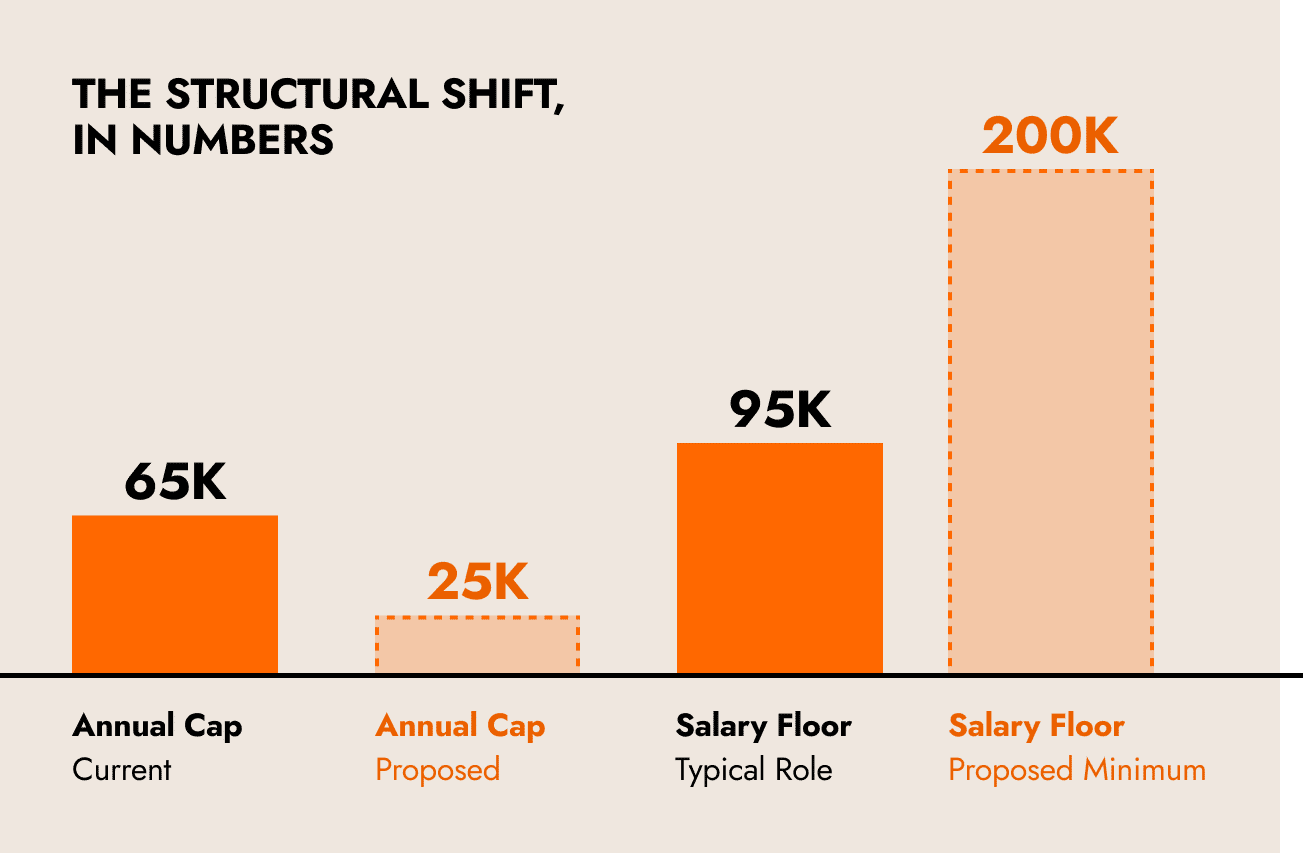
- Annual cap reduced from 65,000 to 25,000 — a 62% cut When the program resumes, the annual cap would be cut from 65,000 to 25,000. All existing exemptions — including cap-exempt positions at universities and nonprofit research organizations — would be eliminated.
- Minimum salary floor of $200,000 The provision with the most immediate structural impact. Median starting salaries for roles historically filled through H-1B — software engineers, data analysts, biomedical researchers, consultants — range from $75,000 to $130,000. A $200,000 floor would disqualify the vast majority of H-1B-eligible positions across all industries.
- Lottery replaced by wage-based selection The current lottery would be replaced by a wage-ranked selection mechanism awarding visas solely to applicants with the highest offered salaries — mirroring reforms already adopted in Canada and Australia.
- H-1B-to-Green Card pathway eliminated The bill would prohibit H-1B holders from adjusting status to permanent residency while in the United States. Workers would be required to physically depart before changing to any other nonimmigrant category.
- Optional Practical Training (OPT) eliminated The bill would end OPT, which currently allows international students to work in the U.S. for 12 to 36 months after graduation. Eliminating OPT would sever the student-to-workforce pipeline and make U.S. graduate programs substantially less attractive — affecting a cohort contributing an estimated $40 billion annually to the U.S. economy.
- Dependent visas and third-party placements eliminated H-1B workers would be barred from bringing dependents on H-4 visas. H-4 EAD work authorization would be eliminated. Third-party placements and “benching” practices would be specifically prohibited. Federal agencies would be barred from sponsoring or employing nonimmigrant workers.
03 — Context: Why this matters even if the bill doesn’t pass
The bill faces a difficult path to enactment. But likelihood of passage is the wrong frame for workforce planning.
The H-1B program has already absorbed a series of significant changes without congressional action: a $100,000 employer fee for new applications filed from outside the United States in September 2025, a wage-weighted lottery reducing selection odds for lower-wage positions, a 37% drop in approvals for Indian nationals, and a 25% fall in total legal H-1B approvals. The DOL recorded a 48% increase in investigations targeting H-1B employers since Project Firewall launched. FDNS unannounced site visits have expanded to include third-party worksites and remote worker residences.
The End H-1B Visa Abuse Act is one data point in a legislative and regulatory trend that is already reshaping the program. Even if the bill fails entirely, component provisions — higher wage thresholds, stricter compliance, reduced outsourcing access, expanded enforcement — have bipartisan support and may advance through separate legislative vehicles or executive action.
04 — Alternatives: The best legal alternatives to H-1B in 2026
For most corporate mobility programs, four pathways cover the majority of use cases that would otherwise default to H-1B — with no lottery, no annual cap, and no dependency on the current legislative environment.
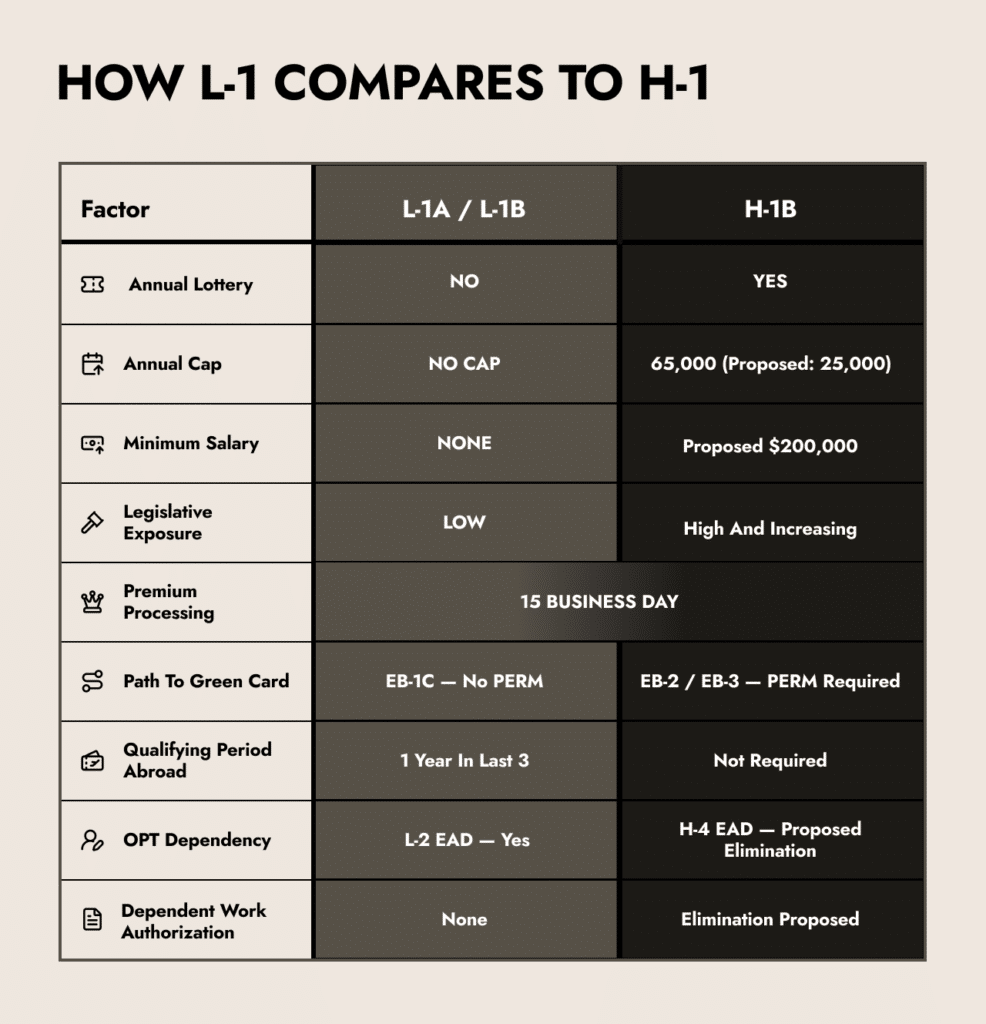
L-1A — Intracompany Transfer: Executives and Managers The L-1A enables an intracompany transfer from a foreign affiliate, subsidiary, or parent in an executive or managerial capacity. No annual cap. No lottery. Eligibility requires one continuous year of qualifying employment abroad within the last three years. Timeline: 2 to 4 months standard, 15 business days with premium processing. Maximum stay: 7 years. L-1A holders have a streamlined path to EB-1C permanent residency without labor certification.
L-1B — Intracompany Transfer: Specialized Knowledge The L-1B covers employees transferring with proprietary, advanced knowledge of the company’s products, processes, systems, or procedures. Same structural requirements as L-1A. Maximum stay: 5 years. No cap. No lottery.
O-1 — Extraordinary Ability The O-1 is a work visa for individuals at the top tier of their field in science, technology, engineering, business, arts, or athletics. Not subject to the H-1B cap. No lottery. Evidence includes original contributions of major significance, high compensation relative to peers, critical roles at distinguished organizations, influential publications or patents. Under 8 CFR 214.2(o), O-1 holders may concurrently have a pending or approved immigrant petition without jeopardizing nonimmigrant status. Initial approval: up to 3 years, with annual extensions.
EB-1C — Multinational Executive Green Card Employer-sponsored permanent residency for executives and senior managers in multinational organizations. No labor certification (PERM) required. April 2026 Visa Bulletin: Current for most nationalities including Brazil and Rest of World. Timeline: 12 to 24 months. Entirely independent of H-1B legislative risk. Functions simultaneously as a retention tool — cost of sponsorship is almost always lower than cost of replacing a senior executive.
05 — Comparison: How L-1 compares to H-1B
06 — Compliance: FDNS enforcement risks right now
FDNS site visits are unannounced inspections conducted by USCIS’s Fraud Detection and National Security Directorate. Under the H-1B Modernization Rule effective January 2025, failure to cooperate may directly trigger petition denial or revocation under 8 CFR §214.2(h). FDNS authority now extends to third-party worksites and remote worker residences.
What FDNS officers review during a site visit:
- Public Access Files for each H-1B employee — LCA, wage documentation, job description
- Form I-129 and supporting documentation
- Pay stubs verifying actual wage paid at or above prevailing wage
- Work location — confirmation employee is working where the LCA states
- Job duties — interviews of employee, supervisor, and coworkers for consistency with petition
- Organizational charts and corporate structure documentation
- Client letters and end-client agreements for third-party placements
- I-9 Employment Eligibility Verification records
Consequences of non-compliance: Revocation of approved H-1B petitions. Referral to ICE for criminal investigation. Loss of ability to sponsor future H-1B workers. Civil fines and criminal penalties. Reputational damage. Increased frequency of future audits across all immigration categories.
Failure to file amendments for location changes is one of the most common violations identified during FDNS inspections. Public Access Files must be established no later than the date the LCA is submitted and retained for at least one year after the end of H-1B employment.
07 — Action plan: What CHROs and legal teams should do this week
Action 1 — Audit your H-1B dependency Map every employee on H-1B status. Identify which roles require H-1B specifically and which could qualify for L-1 or O-1. Key questions: How many H-1B holders are approaching status expiration in the next 12 months? How many are managers, executives, or employees with specialized proprietary knowledge? Which employees are in third-party placements directly affected by the outsourcing restrictions?
Action 2 — Identify your L-1 and EB-1C candidates Any employee who has worked for your organization or a qualifying related entity for at least one continuous year within the last three years in a managerial, executive, or specialized knowledge role has a potential L-1 pathway available now. For senior leadership on H-1B who meet EB-1C criteria, Green Card sponsorship may be initiated immediately. The April 2026 Current status makes this an unusually favorable window.
Action 3 — Assess your O-1 population A structured O-1 eligibility assessment of high-performing technical and professional staff regularly reveals candidacy where the employee assumed they wouldn’t qualify. Engineers with patents, publications, or contributions of major significance; business leaders with high compensation relative to industry peers; scientists with invited judging experience or selective memberships — these profiles qualify without celebrity recognition.
Action 4 — Review your H-1B compliance posture Before any FDNS visit: verify Public Access Files are current and accessible for each H-1B worker; confirm LCA wages match actual compensation; check that worksite documentation matches the LCA location for all workers including remote employees; review third-party placement arrangements for compliance with current regulations. A proactive compliance review is significantly less disruptive than an FDNS site visit.
Action 5 — Build global location optionality Organizations with existing entities in alternative global hubs — Dubai, London, Singapore, Lisbon — can activate mobility pathways rapidly if U.S. access narrows. Organizations building from scratch under pressure face a substantially longer timeline. The time to build global optionality is before you need it.
08 — Outlook: Is the End H-1B Visa Abuse Act likely to become law?
In its current form: unlikely. Three scenarios are worth monitoring for workforce planning purposes.
Scenario 1 — Bill fails, enforcement continues The most likely near-term outcome. The bill does not advance, but the regulatory and enforcement environment continues to tighten through existing executive authority. This is already the current operating environment.
Scenario 2 — Partial provisions advance Component elements advance through separate legislation or executive action. Higher wage thresholds, outsourcing restrictions, and OPT limitations each have independent political constituencies and could move independently of the full bill.
Scenario 3 — Broader legislative package The bill is folded into a larger immigration reform package and survives in modified form — with a lower salary floor, a shorter freeze, or a phased implementation. This is the scenario that most directly affects mobility program planning for FY2028 and beyond.
09 — Frequently asked questions
What happens to current H-1B employees if the freeze passes? The bill’s current text includes provisions requiring existing H-1B holders to “gradually exit.” Extensions and renewals are not clearly addressed. Employees currently in the traditional six-year H-1B pipeline would not maintain the status quo. Organizations should begin transition planning for at-risk employees now — the window for L-1 or O-1 transition is longer than most HR teams assume.
Can a company switch an H-1B employee to L-1 status? Yes, if the employee meets L-1 eligibility requirements — primarily one continuous year of qualifying employment abroad within the last three years in a managerial, executive, or specialized knowledge role at a related entity. The transition requires filing a new petition and does not depend on any lottery or cap.
Does the H-1B freeze affect OPT students currently working in the U.S.? The bill proposes eliminating OPT entirely. Students currently on OPT would face significant uncertainty about their status and their path to a work visa. The bill does not clarify transition provisions for current OPT holders.
What is the difference between L-1A and L-1B? L-1A covers executives and managers — those who direct the organization or a major component, set goals and policies, and exercise wide decision-making latitude. L-1B covers employees with specialized, proprietary knowledge of the company’s products, services, processes, or systems. L-1A maximum stay is 7 years; L-1B maximum stay is 5 years. L-1A holders have a streamlined path to EB-1C permanent residency.
Can an O-1 visa holder apply for a Green Card at the same time? Yes. Under 8 CFR 214.2(o), an O-1 applicant may concurrently have a pending or approved immigrant petition without jeopardizing their nonimmigrant status. O-1 can function as both immediate work authorization and a bridge to permanent residency planning.
What is EB-1C and who qualifies? EB-1C is employer-sponsored permanent residency for multinational executives and managers. The employee must have been employed by the petitioning employer or a qualifying affiliate abroad in an executive or managerial capacity for at least one continuous year within the three years preceding the petition. No labor certification is required. In April 2026, EB-1C is Current for most nationalities on the Visa Bulletin — meaning no priority date backlog.
What documents must an H-1B employer have ready for an FDNS site visit? Public Access Files including the Labor Condition Application, wage documentation, and job description for each H-1B worker. Form I-129 and approval notices. Pay stubs. Worksite documentation matching the LCA location. Client letters and end-client agreements for third-party placements. I-9 records. Organizational charts. FDNS officers arrive unannounced and non-cooperation can result in petition revocation under 8 CFR §214.2(h).
Request a corporate immigration review from HAYMAN-WOODWARD
HAYMAN-WOODWARD advises CHROs, CFOs, and legal teams on corporate immigration strategy, compliance architecture, L-1 and O-1 program design, and employer-sponsored Green Card programs across the United States, Dubai, Europe, and Brazil. For a review of your organization’s current H-1B exposure and the legal alternatives available to your workforce, contact our corporate legal team.