


EB-1 and EB-2 NIW Remain Current — But the State Department Just Confirmed Retrogression Is Coming

The U.S. Department of State released the June 2026 Visa Bulletin earlier this month — the monthly document that determines who can move forward on a Green Card petition, when, and from which priority date.
For most applicants outside India, China, Mexico, and the Philippines, the headline news remains favorable: EB-1 and EB-2 NIW are Current.
But buried inside the same bulletin is an official warning that very few are reading carefully: retrogression may be necessary in the coming months.
That is not the kind of detail that makes a headline. It is the kind of detail that decides whether your Green Card petition moves now or waits another year.
WHAT IS CURRENT IN JUNE 2026 FOR ROW APPLICANTS
For applicants from Brazil, Portugal, Italy, Colombia, Argentina, the United Kingdom, Germany, the United Arab Emirates, and most of the world, categorized under “All Chargeability Areas Except Those Listed” the picture remains favorable:
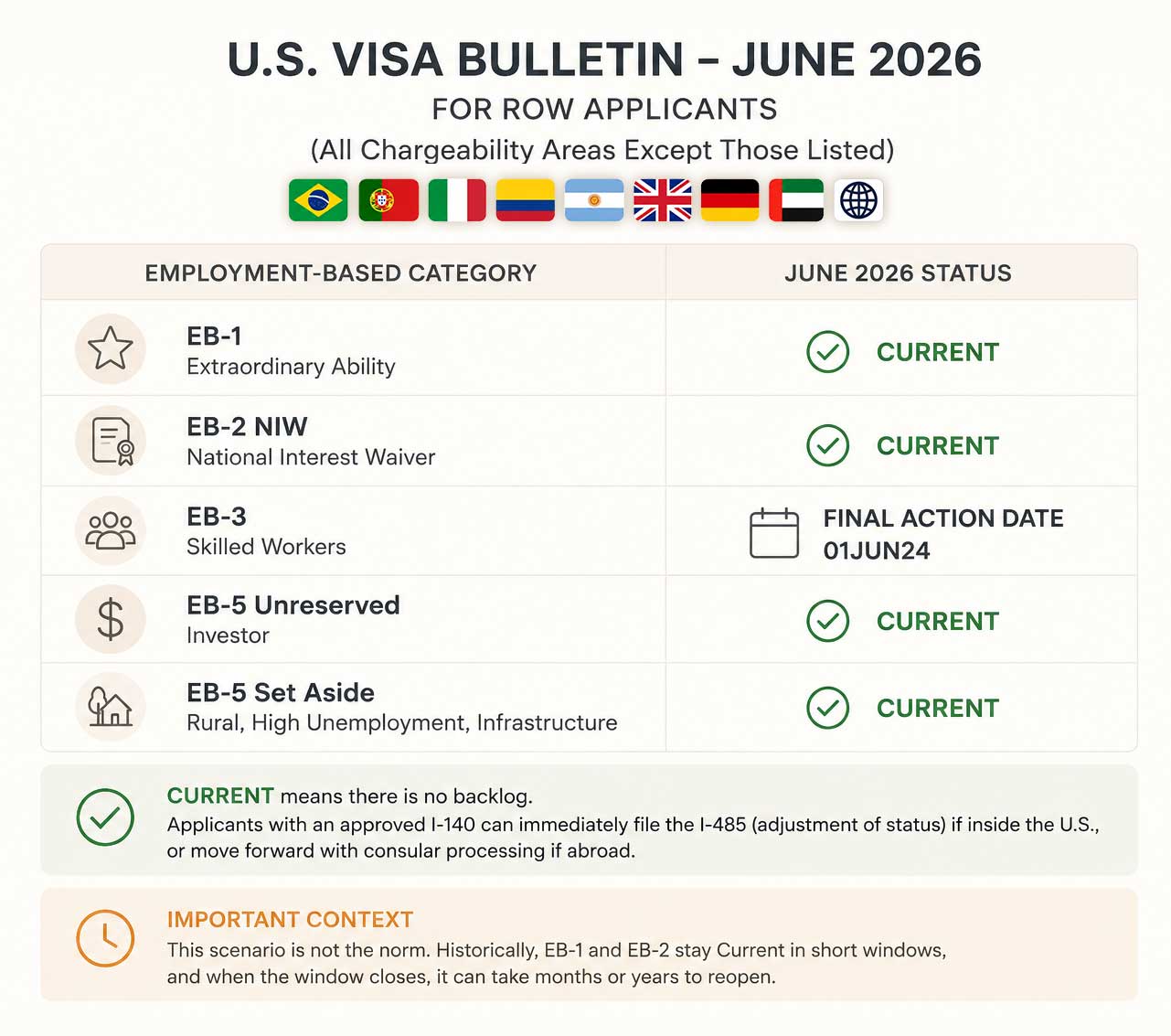
- EB-1 (Extraordinary Ability): Current
- EB-2 NIW (National Interest Waiver): Current
- EB-3 (Skilled Workers): Final action date 01JUN24
- EB-5 Unreserved (Investor): Current
- EB-5 Set Aside (Rural, High Unemployment, Infrastructure): Current
Current means there is no backlog. Applicants with an approved I-140 can immediately file the I-485 (adjustment of status) if inside the United States, or move forward with consular processing if abroad.
This scenario is not the norm. Historically, EB-1 and EB-2 stay Current in short windows, and when the window closes, it can take months or years to reopen.
THE WARNING MOST READERS ARE IGNORING
In Section D of the June bulletin, the State Department is explicit:
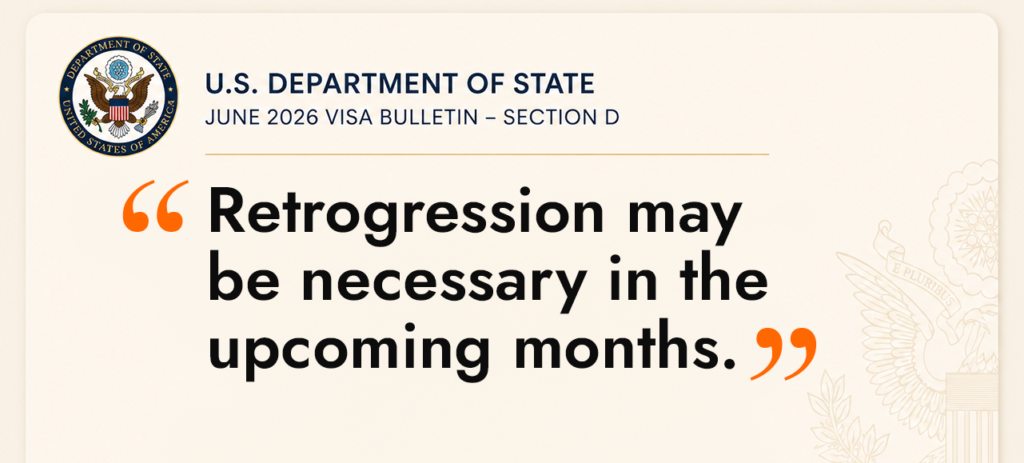
“Note that as additional immigrant visa demand materializes, or administration actions are amended, retrogression may be necessary in the upcoming months to keep issuances within annual limits. Visa categories may become ‘Unavailable’ prior to the end of the fiscal year if annual limits, category limits, or pro-rated per-country limits are reached.”
Translated into strategic terms: the U.S. government has officially confirmed that the window may close before September 30, 2026.
The logic is straightforward. When a category becomes Current, filing volume surges. When filing volume surges, the annual limit is reached faster. When the annual limit approaches, the only way to keep issuances within the cap is to retrogress priority dates, or suspend the category altogether.
Professionals who are hesitating, gathering documents at their own pace, or waiting for “the right moment” are now competing against the State Department’s clock.
THE LESSON INDIA IS TEACHING IN REAL TIME
Section E of the bulletin is the part nobody is sharing on LinkedIn, but it should be required reading for any global professional considering a U.S. Green Card.
India retrogressed in both EB-1 and EB-2 this month.
EB-1 for India is now at December 15, 2022. EB-2 is at September 1, 2013, a backlog exceeding 12 years. And the bulletin explicitly warns that further retrogressions or full unavailability may follow if India’s pro-rated per-country limit is reached before the fiscal year ends.
This is what happens when demand outpaces supply in a category. It is also why Indian professionals who historically filed under EB-2 are now migrating en masse to EB-1A, because for them, the EB-2 window has effectively ceased to exist.
The message for everyone else is direct: your window exists. But it exists now.
Considering EB-1A or EB-2 NIW?
Speak directly with a senior strategist at HAYMAN-WOODWARD.
OTHER WARNINGS IN THE BULLETIN THAT DESERVE ATTENTION
The document carries three additional signals that point to where the system is headed:
- EB-2 for China (Section F): demand is high enough to force retrogression or unavailability in the coming months.
- EB-3 for the Philippines (Section G): same situation. Retrogression likely.
- EB-5 Unreserved for India (Section H): possible retrogression as early as next month.
When three different categories receive the same warning in the same bulletin, the pattern is clear. The system is contracting, not expanding.
WHAT THIS MEANS IN PRACTICE FOR APPLICANTS ABROAD
For applicants outside the United States, the path forward requires strategy, not delay.
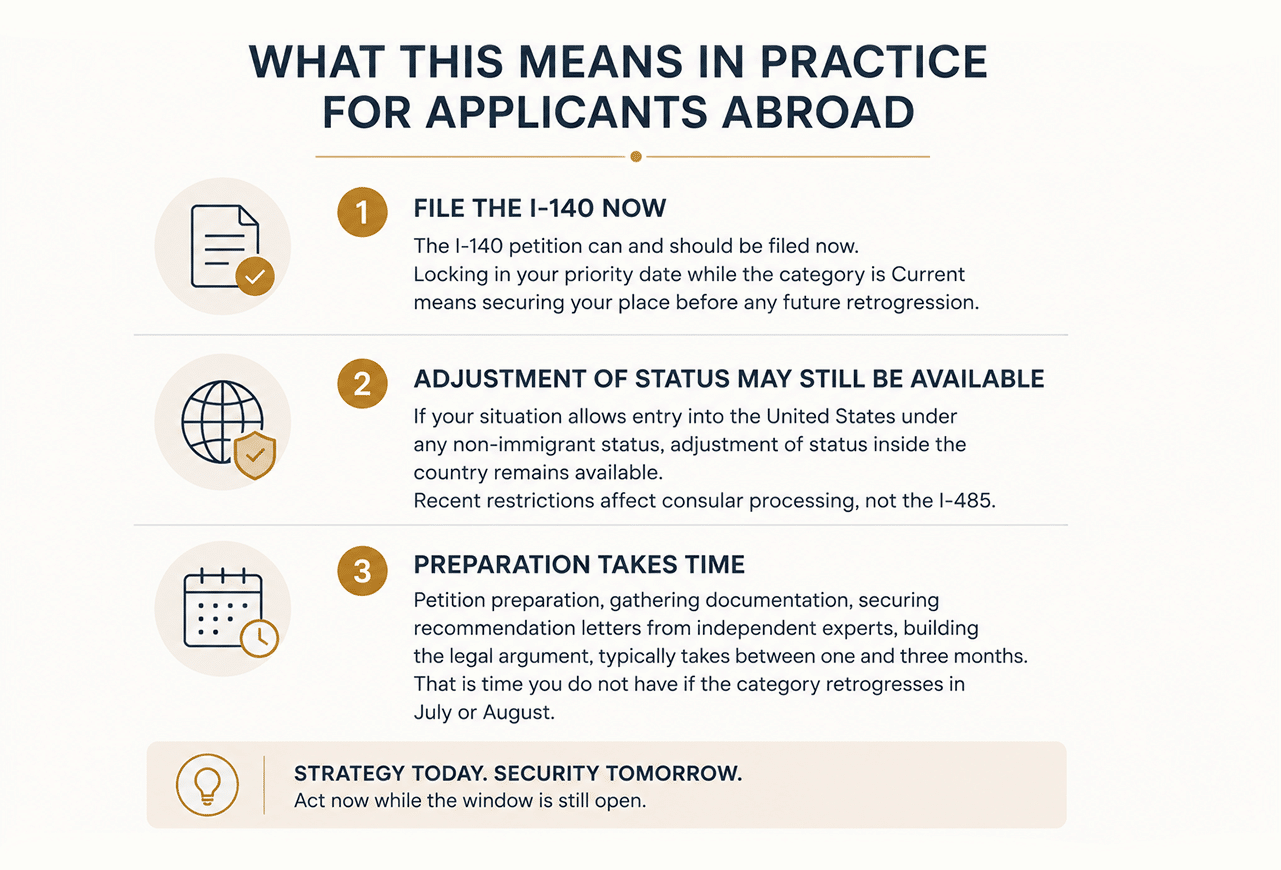
First: the I-140 petition can and should be filed now. Locking in your priority date while the category is Current means securing your place before any future retrogression.
Second: if your situation allows entry into the United States under any non-immigrant status, adjustment of status inside the country remains available. Recent restrictions affect consular processing, not the I-485.
Third: petition preparation, gathering documentation, securing recommendation letters from independent experts, building the legal argument, typically takes between one and three months. That is time you do not have if the category retrogresses in July or August.
WHAT THIS MEANS IN PRACTICE FOR APPLICANTS INSIDE THE U.S.
If you are inside the United States in valid status with an approved I-140 and the EB-2 or EB-1 category Current, you can file the I-485 immediately.
While the I-485 is pending, you can apply for the Employment Authorization Document (EAD) and Advance Parole, typically issued in 6 to 12 months, granting independent work authorization and international travel rights before the Green Card itself is approved.
This is the part that changes lives for professionals tied to employer-sponsored visas. The EAD removes the dependence on a single employer signing your status. The Green Card follows. Freedom comes first.
But this entire path assumes the category is Current when you file. If retrogression hits before you submit, the window closes for an unknown period.
THE DECISION THAT NEEDS TO BE MADE THIS WEEK
Not next week. This one.
The June bulletin is a favorable snapshot. The July bulletin may look different. The August bulletin, depending on June filing volume, may look very different.
The difference between filing now and filing in three months can be a priority date that holds years of value.
HAYMAN-WOODWARD has been monitoring this document monthly for three decades. Based on the explicit signals the State Department is sending, what we are seeing now is a window closing, not opening.
If your profile qualifies for EB-1A or EB-2 NIW and you have been waiting for the “right moment” to begin, that moment is now.
Speak directly with a senior strategist at HAYMAN-WOODWARD:
Frequently Asked Questions About the June 2026 Visa Bulletin
Is EB-2 NIW Current for Brazilians in June 2026?
Yes. EB-2 NIW is Current for All Chargeability Areas Except Those Listed, which includes Brazil, Portugal, Italy, Colombia, and most of the world.
What is the difference between Current and a final action date?
Current means there is no backlog and visa numbers are immediately available. A final action date means only applicants with priority dates earlier than that date can be issued a visa.
What does retrogression mean on the Visa Bulletin?
Retrogression occurs when a previously Current or recent priority date moves backward, restricting visa issuance. It happens when demand exceeds the available annual numbers for a category.
When is the next Visa Bulletin released?
The State Department typically releases each Visa Bulletin in the second or third week of the preceding month. The July 2026 bulletin is expected mid-June.
Can I file the I-140 even if I’m outside the U.S.?
Yes. The I-140 petition can be filed regardless of physical location. Filing locks your priority date — your position in the queue — independent of when consular processing resumes.